

Culture Study part 4 of 5: Religion in Culture
You can download the whole study HERE
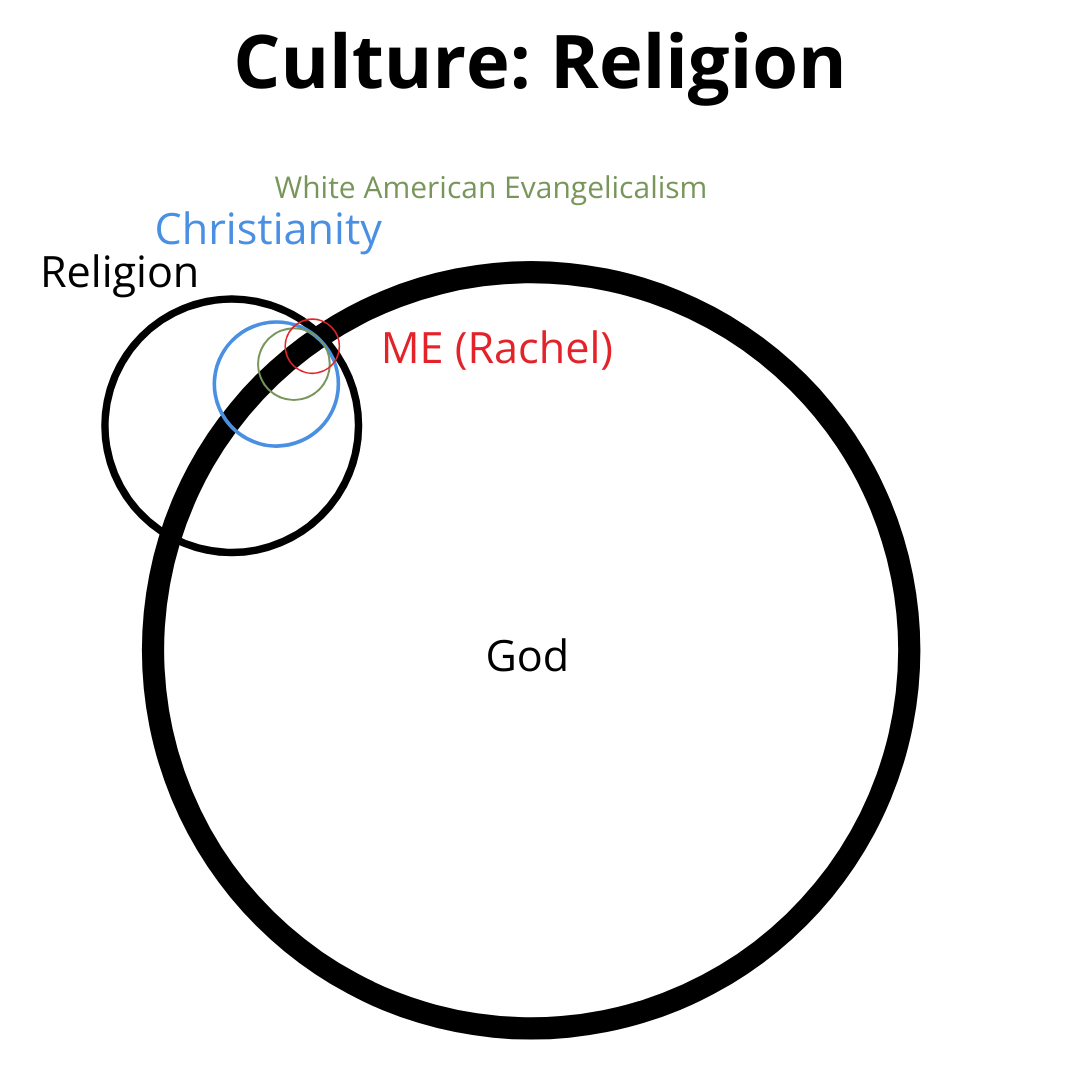
Thank goodness that God is bigger (much bigger) than religion: and bigger than our culture. Religion is just how our finite minds try to understand an infinite God. I am guessing we have some of it right, and some of it wrong (just like with everything else in life). One religion is Christianity. It is the religion that I hold to. One part of Christianity that I have been around most of my life is white American Evangelicalism: this is just one way Christianity has been interpreted over the years, in one specific location, by one (socially constructed) racial group. If I try to place myself in where I fit culturally, it is mostly within white American Evangelicalism, hopefully mostly rooted in Christ. But part of me doesn’t feel like I fit inside of religion as I know it, or Christianity as I know it, or white American Evangelicalism as I know it. And I know I don’t have everything about God right—that’s a long sanctification process. This is part of what makes culture discussions so complex. Many people don’t realize all of the layers (I am sure you could add MANY MORE to my graphic) that make up what they call their religious culture (let alone all of the other aspects of culture). It makes it hard to understand what is man-made, and what is actually connecting with and following God rather than some man-made version.
I try to see culture through a different lens. Christianity means following Christ. It means giving my life to Christ: “I live; yet not I, but Christ liveth in me: and the life which I now live in the flesh I live by the faith of the Son of God…” (Galatians 2:20). That means culture (HOW I do life) is not mine, or up to me, but Christ’s, and up to Him. Do I actually live this out? Not all the time, but hopefully a little more than yesterday: that is the sanctification process. So for me, as a Christian, it isn’t about what my culture is: but how can I live Christ’s culture within the culture that I am in. Figuring out how I can (in the graphic) move my little circle farther into the God circle in ALL aspects of culture and life.

From marriage to community, we can all benefit from cross-cultural skills. What about at church? There is a reason why people say that 10am on Sunday is the most segregated time in America. Every church has a culture (within a culture, within a culture…): hopefully, it is a Jesus culture. Hopefully, everyone in the church is actively working to let go of their individual cultures and layers and taking on the culture of Christ. But it is important to identify (on all levels), where we’ve made our culture our idol. And not, God forbid, claim our culture is that of Christs’ when it isn’t.
There is a talking point of “But if our culture has more Christian values in it, doesn’t that make it better than cultures that don’t have those Christian values?” Any person, working toward a culture of Christ, will hopefully live out a healthier life and culture. But that same person, I believe, would hopefully be aware that it doesn’t make their culture (or themselves) “better” than anyone else. That is asking the wrong question, and reveals a wrong focus. We do not serve God, or have Christian values to have a better culture, or a better life: that is serving a vending machine god, not the God of the Bible. To assume that a whole group of people, such as a country, has Christian values that actually reflect Jesus, and thus has a “better” culture than another country is not understanding how God works on the margins, not through power. It is not listening to the voices that are calling out the injustices happening in our culture because of that “Christian nation.” It does not have an understanding of the weaknesses within its own culture, that has put a Christian label on things that Jesus abhors.
We can be grateful for the blessings that come from following Christian values, while realizing that doesn’t mean our culture has been sanctified. To use Christ to create hierarchies of culture is anti-Christian, and always has been when we’ve seen it in history. We do not serve God because of how He makes our culture better, but because we come to recognize that HE is the best. We do not tell others (near and far) about Jesus because we want them to have a better culture, or a better life, but because we have found Someone wonderful we want to share with them.
How we see our culture, and how we understand how God works through culture, will affect how we do missions. As Rob Bell put it, with a dash of humor: “Missions is less about the transportation of God from one place to another are more about the identification of God who is already there. It is almost as if being a good missionary means having really good eyesight. Or maybe it means teaching people to use their eyes to see things that have always been there; they just didn’t realize it. If you see yourself as carrying God to places, it can be exhausting. God is really heavy.” Missionaries have an important job of recognizing and reckoning with the damage that has been done from those who said they were “exporting God” through missions when really, they were exporting their culture and agenda.