

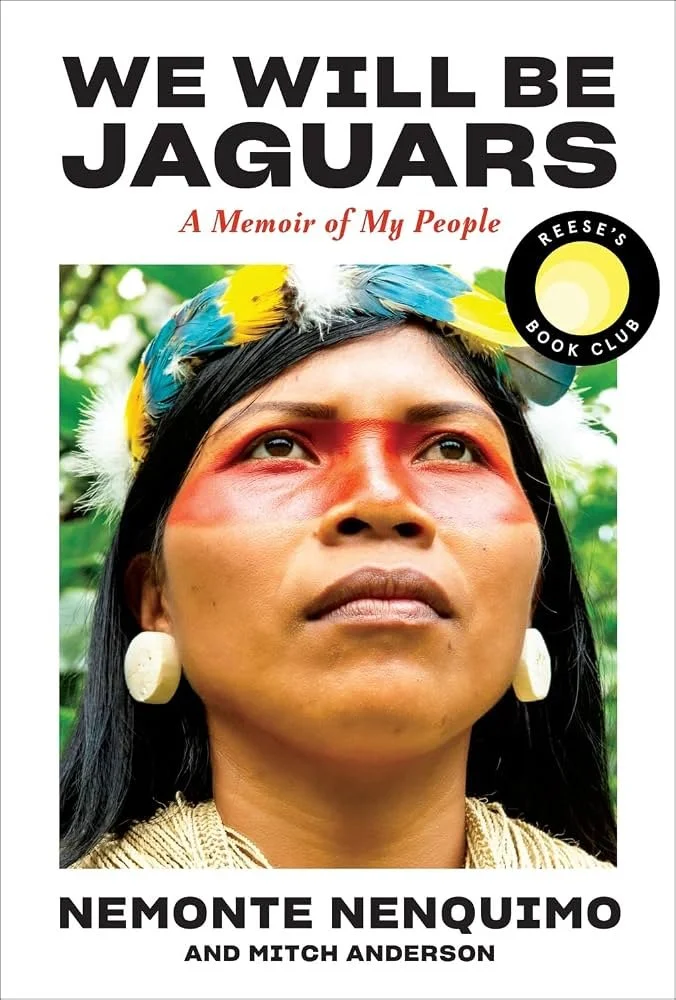
I suggest reading We Will Be Jaguars by Nemonte Nenquimo not only because of her personal story, but because of the different (and additional) perspective it gives on a story you may think you already knew.
Nemonte is from the Waorani tribe in Ecuador, the same tribe whose members killed Jim Elliot, Nate Saint, and the other missionaries who came to reach them with the gospel. She belongs to the next generation: the generation that knew Rachel Saint, Nate Saint's sister, who came to live among the Waorani and remained there until near the end of her life (after the time Elizabeth Elliot was there).
This was not a retelling of the initial missionary encounter. It's a story about what happened afterward—what it was like for the next generation to grow up in the middle of two very different worlds.
Nemonte had an early fascination with everything the white people brought. She wanted the things they had and the life they seemed to offer. She even had her teeth pulled out because she wanted the white, straight teeth she associated with the missionaries.
She eventually ran away from her family to attend a mission school. There, she was introduced to the city and a different way of life. But she also experienced sexual abuse, confusion, and tremendous pain. She found herself caught between worlds, having left behind much of what she knew without finding what she was looking for in the new one.
This reminded me of a common story I've heard from many immigrants, including my husband. There is often a push and pull when two cultures collide: the alienation of one culture in favor of embracing and assimilating to another. The things associated with the new culture can seem so desirable that people begin to reject their own history, traditions, and way of life: even of their own family.
Sometimes it takes years of personal growth and experience to look back and recognize the important things you threw away in the rush to grab something new. And sometimes the new things weren't what they were promised to be.
Nemonte's experience makes this especially powerful because she was only one generation removed from a community that had been largely unreached. She watched her parents struggle with the arrival of Christianity and Western culture, and then experienced those tensions herself. She saw the changes, the attractions, the losses, and the contradictions from the perspective of a child growing up in the middle of it all.
Eventually, much of her story becomes about returning to her people and rediscovering the value of their stories, traditions, relationships, and ways of living with the land rather than destroying it.
One of the most important distinctions in the book is the difference Nemonte makes between Rachel Saint's faith and the faith of Rachel's nephew and his family, who came later. I think Nemonte recognized a difference between wanting the things associated with Christianity and embracing the Jesus of Christianity.
That is an important distinction for anyone involved in missions. We can unintentionally communicate that becoming a Christian means becoming more like us—adopting our clothing, customs, education, or cultural preferences. But becoming a follower of Jesus does not require becoming Western.
There is a difference between introducing people to Christ and introducing them to our culture. This doesn't mean every cultural practice should be preserved or that every tradition is compatible with biblical Christianity. It means we need to distinguish between what Scripture teaches and what we personally prefer. We should be careful not to confuse our cultural assumptions with biblical convictions.
Some people might read this book as a rebuke against missionaries, but that wasn't how I interpreted it. Nemonte certainly exposes the failures of people who claimed Christianity while behaving in ways that contradicted it. Her experience of sexual abuse, particularly within a Christian institution, is painful to read. She also points out the hypocrisy of people who used the appearance of Christianity to justify or conceal their actions, particularly connected to money.
That deserves to be taken seriously. We shouldn't dismiss someone's experience simply because acknowledging it makes a missionary story more complicated. At the same time, I don't think her account erases the genuine faith of many of the missionaries involved in the story. In fact, Nemonte's ability to distinguish between different expressions of Christianity is one of the more interesting parts of her story.
The failures of some Christians do not invalidate the faithfulness of others. But neither should the faithfulness of some be used to excuse the failures of others. This is also a reminder of the danger of putting missionaries on pedestals. We sometimes tell missionary stories in ways that make the missionaries seem almost larger than life. Their courage, sacrifice, and faith become the focus, and we can unintentionally make them seem untouchable.
But missionaries are people. They are imperfect, capable of making mistakes, and sometimes capable of doing terrible things. We should be able to appreciate genuine faithfulness without feeling the need to protect someone's reputation at the expense of the truth. Eventually, the truth about people's lives and actions comes to light. It is better to tell honest, complicated stories than to build our understanding of missions around idealized heroes.
Early in Nemonte’s life, she embraced all that the oil companies brought into her community. Later, after returning to a deeper appreciation of her people's history and values, she became a leader in fighting against the oil companies and the exploitation of her people's land.
Much of the book focuses on this transformation and her determination to protect the Amazon and the future of the Waorani. Her fight is much more directly aimed at the oil companies and those willing to exploit vulnerable people and communities for profit than it is at Christianity itself.
It also raises important questions about what we mean when we talk about development and progress. Who gets to define what a better life looks like? Who benefits when a community's resources are extracted? And what is lost when economic opportunity is measured without considering the people, relationships, and environment affected?
Nemonte's story challenges the assumption that Western ideas of progress are automatically better. It reminds us that people can have valuable knowledge, wisdom, and ways of life that outsiders should be willing to learn from.
One unexpected thing I found myself thinking about was language. The book is written in English by Nemonte's husband, who has worked to translate her story from her original Indigenous language and Spanish. There is some swearing in the book, which made me curious about the translation process. In which language was she swearing? How do you translate the way someone expresses anger, frustration, humor, or pain when those expressions are rooted in a different language and culture?
It made me think about the complications involved in translating someone's story—and, especially, translating your own story into words, and then through someone else's words.
Nemonte mentions that the Christians didn’t translate the word “Jaguar,” because it wasn’t in the Bible. It wasn’t valuable to them, even though it was foundational to the Waorani people. What about words that don't have direct equivalents? What about the cultural nuances that an English-speaking reader will never quite understand? How much does a translator's own perspective shape the way a story is communicated?
These questions are particularly interesting when reading stories from people whose communities have historically been described and interpreted primarily by outsiders. There is something important about allowing people to tell their own stories, even when the process of communicating those stories across languages is complicated.
As Nemonte said, “For us, stories are living beings…A story dies when no one tells it.” And finally: “What will you do with my story now that it has been written? I hope you will let it live.”